


Every server, network and permission defined in code you own
When infrastructure is built by hand, it cannot be reviewed, repeated or recovered reliably. DoneDeploy turns your infrastructure into code with Terraform, Pulumi and Packer, with AI drafting modules and checking plans, and engineers approving every apply. You end up with environments that can be rebuilt from Git and changes that are reviewed like any other code.
- Fixed price
- Free first call
- In your own cloud


From design to implementation, and everything after
What goes wrong without it
Environments that differ
Staging and production were built separately by hand, so something that works in one fails in the other.
Changes with no record
Nobody can say who changed a security group or why, because the change was made in a console.
Slow recovery
Rebuilding a lost environment means reconstructing it from memory and screenshots.
What we do
- Import existing resources into Terraform or Pulumi without recreating them
- Write reusable modules for networks, compute, databases and access
- Use AI to draft modules and to review every plan for risky changes before an engineer approves it
- Build machine images with Packer and keep secrets in Vault or your cloud's secret store
- Run plans and applies from a pipeline, with state stored safely and locked
- Detect drift between code and the real environment and report it
What you get
- Infrastructure code and modules in your Git repositories
- A pipeline that plans on every change and applies after approval
- Documentation of modules, state layout and conventions
- A runbook for rebuilding an environment from code
From first call to continuous improvement
Free first consultation
We look at how your infrastructure is built today and what you want under code first.
Inventory
AI helps us list existing resources and their dependencies, and engineers check the result.
Fixed-price proposal
We agree the scope, the tools and the order of work at a fixed price.
Codify and pipeline
We import and write the code, then wire plans and applies into your CI/CD with human approval.
Improve after launch
We review drift, module quality and cost and keep the code tidy as the infrastructure grows.
 Vault
 AWS
 Google Cloud
 Azure
 GitHub Actions
Related articles
 Best Practices for Secrets Management: The Order We Fix Things InSecrets management best practices in the order that pays off: inventory, scanning, a central store, short-lived credentials, Kubernetes delivery and a practised leak response.
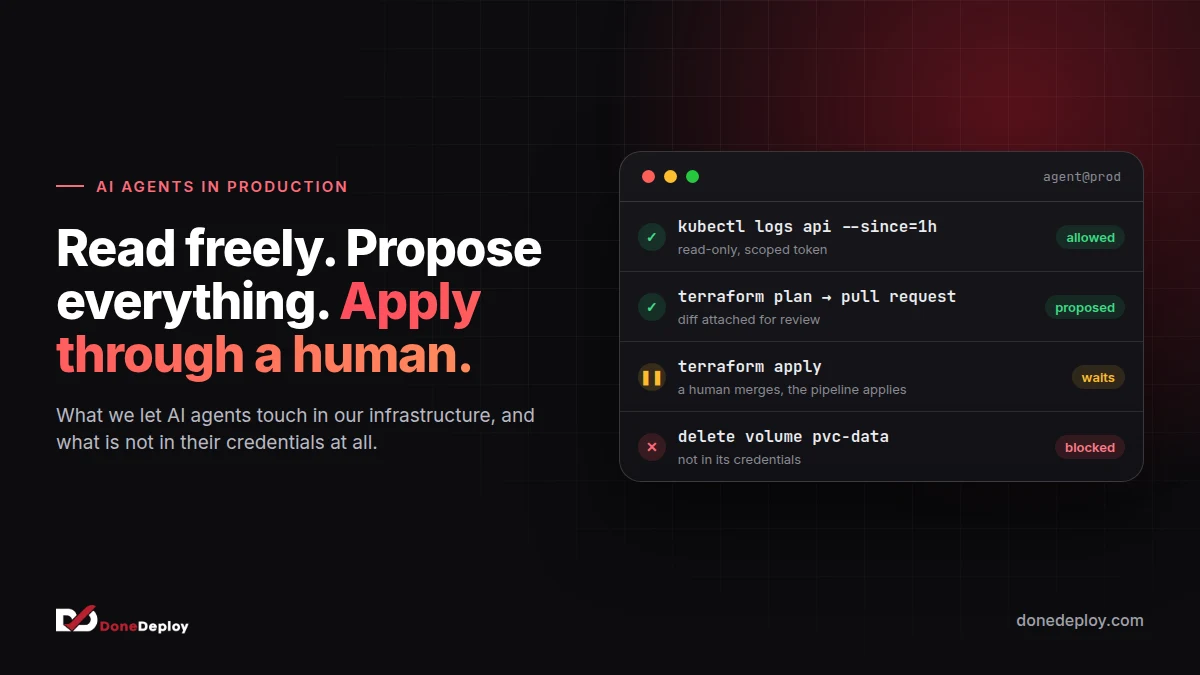 AI Agents in Your Infrastructure: What We Let Them TouchAI agents can read logs, write Terraform and open pull requests. Here is where we draw the line in production: read freely, propose everything, apply only through a human.
 Ephemeral Environments in DevOpsDiscover how ephemeral environments accelerate DevOps workflows, reduce costs, and improve collaboration with automated, temporary testing setups.
Often done together
Frequently asked
Terraform or Pulumi?
Terraform suits most teams and has the largest ecosystem; Pulumi suits teams who prefer writing infrastructure in a general-purpose language. We recommend one based on your team's skills.
Does AI apply changes on its own?
No. AI drafts code and reviews plans, but every apply to production is approved by an engineer.
Do we have to rebuild everything?
No. Existing resources can be imported into code as they are, so the move happens without downtime for most resources.
Tell us what you run and what you want to change. We reply personally, and the first consultation is free.
Let's talk »