
Category
Devops
DevOps is a set of practices, tools, and a cultural philosophy that automate and integrate the processes between software development and IT teams . It emphasizes team empowerment, cross-team communication and collaboration, and technology automation.
66 articlesAll articles » The CI Process, Step by Step: What Runs Between Push and MergeA practical CI process in the order we build it: fast checks first, one build, tests in layers, scans, and a single artifact that every later stage reuses.
 Blameless Postmortems: The Incident Review That Changes SomethingHow to run a blameless incident postmortem that leads to real fixes: when to write one, the template we use, the meeting, and action items that get done.
 Best Practices for Secrets Management: The Order We Fix Things InSecrets management best practices in the order that pays off: inventory, scanning, a central store, short-lived credentials, Kubernetes delivery and a practised leak response.
 SLOs and Error Budgets: Agreeing How Reliable Is Reliable EnoughHow to set your first SLOs and error budgets: pick the user journeys, choose an SLI you can measure, set a target you can defend, alert on burn rate and agree what happens when the budget runs out.
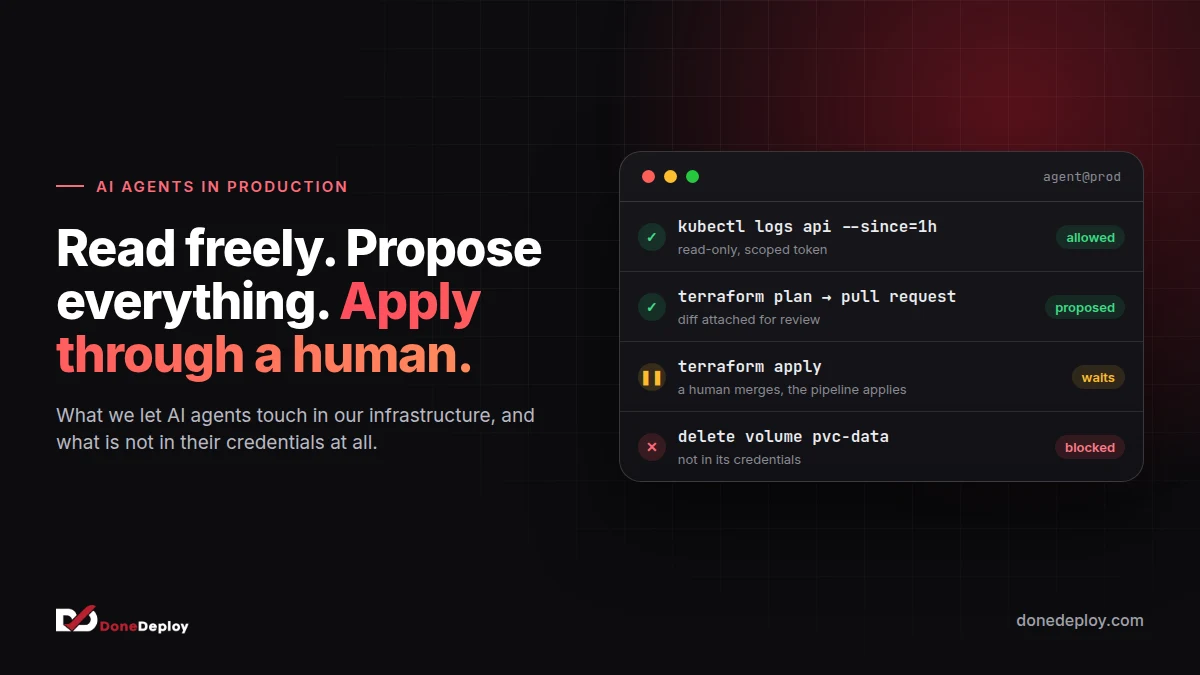 AI Agents in Your Infrastructure: What We Let Them TouchAI agents can read logs, write Terraform and open pull requests. Here is where we draw the line in production: read freely, propose everything, apply only through a human.
 From Idea to AI Feature in Six WeeksHow an AI project runs end to end in six weeks: discovery, design, prototype, infrastructure, rollout, then measuring and improving.
 CI/CD for Models and PromptsEvaluation gates, model registries, canary releases and rollback: applying CI/CD discipline to prompts and models in LLM applications.
 Observability for LLM ApplicationsWhat to measure in an LLM application: tokens, latency, cost per request, OpenTelemetry traces and the quality signals that show when answers get worse.
 GPU Nodes on Kubernetes Without Wasting MoneyNode pools, MIG, time-slicing, scale to zero and spot instances: practical ways to keep Kubernetes GPU costs under control for AI workloads.