
Internal Developer Platform: The Smallest One Worth Building
An internal developer platform does not need a portal or a platform team. Start with one golden path, a service template and preview environments per pull request.

Search for “internal developer platform” and you will find architecture diagrams with a portal, a service catalogue, a scorecard system, an orchestrator and a dedicated platform team to run it all. For a company with hundreds of engineers, that can be the right answer. For a team of ten or forty, it reads like a reason not to start.
The problem a platform solves shows up long before that size, though. A developer needs a new service, a database or a place to test a change, and the answer is a ticket to the two people who understand the infrastructure. They are busy, so the developer waits, or copies the last service’s setup and changes what looks different. Six months later every service is deployed a little differently and nobody is sure which copy is the good one.
This post is about the other end of the scale: the smallest internal developer platform that actually removes that queue, what goes in it first, and what can wait.
What an internal developer platform is, without the diagram
An internal developer platform is the set of ready-made, supported ways your developers create, ship and run software without asking someone else to do it by hand. That is all. It can be a portal with buttons, but it can just as well be a Git repository of templates and a few workflows that run when a pull request is opened.
Two words carry most of the meaning:
- Golden path. The recommended way to build, test, deploy and monitor a service. Not the only allowed way, but the one that is documented, maintained and already works.
- Self-service. A developer can get what the golden path offers without a ticket, inside guardrails someone has agreed on.
If developers can start a new service and see their change running somewhere real without waiting on anyone, you have a platform, whatever it looks like.
Signs you need one, at any size
- New services take days to set up, and most of that time is waiting.
- Each service has its own pipeline, its own Helm chart and its own idea of logging.
- Reviewers read code they cannot run, because building an environment to try it is too slow.
- One or two people are on every infrastructure thread, and their holidays are a risk.
- The answer to “how do we deploy a new service?” is the name of one person.
None of these is solved by buying a portal. All of them are solved by deciding on one way to do the common things and making that way the easiest.
Build it in this order
1. Find the most common request
Before writing anything, look at what developers actually ask for. Read the last few months of infrastructure tickets and chat threads, and talk to the developers who wait the most. In most teams a short list covers the majority: a new service, a new environment, a database, a secret, a DNS name, access to logs.
Pick the one that is requested most often and hurts the most. That is the first golden path. Everything else waits.
2. Write the golden path down, then make it a template
Decide how a service on your stack is built, tested, deployed and monitored, and write it down as a short page a new developer could follow. Then turn that page into a template: a new repository that already contains
- the CI pipeline, following the stages your team agreed on (if you have not agreed on them yet, our CI process post is a starting point),
- a Dockerfile and a Helm chart with sensible defaults for resources, probes and labels,
- logging, metrics and tracing wired in, for example with OpenTelemetry,
- secrets fetched from your store, not pasted into variables (see Best Practices for Secrets Management).
A developer who starts from the template gets all of it on day one. The platform team, even if that is one person part time, maintains one template instead of reviewing twenty slightly different setups.
3. Self-service through Git, with guardrails
The simplest self-service interface is the one your developers already use: a pull request. A developer who needs a new environment or a database adds a short file to a repository; checks validate it against the rules (sizes, regions, naming, cost limits); an engineer approves it; and a tool such as Terraform or Argo CD applies it.
This keeps every request reviewed, recorded and reversible, and it needs no new interface to learn. A portal can come later, as a nicer front door to the same workflows, once you know which requests deserve one.
4. Preview environments per pull request
This is the part developers notice first, and the one that most changes how a team reviews code.
Here is how it works in practice. A developer opens a pull request that changes the checkout flow. The pipeline builds the image once, then deploys it to a fresh namespace on the Kubernetes cluster with its own address, using the same Helm chart as production with smaller settings. The pull request gets a comment with a link. The reviewer, the product owner and the tester click it and try the change instead of imagining it. When the pull request is merged or closed, the namespace is deleted.
A few rules keep preview environments useful rather than expensive:
- Same chart, smaller values. If the preview is built differently from production, it will hide the bugs you wanted to find.
- Seeded test data, never production data. A preview with copied customer records is a leak with a URL.
- Delete on close, and on a timer. A pull request abandoned for weeks should not keep a namespace running.
- Shared dependencies where it is safe. Not every preview needs its own database cluster; a schema or database per preview on a shared server is often enough.
5. Measure, then grow
Once one golden path is in use, measure it: how long a new service takes to reach its first deploy, how many requests still arrive as tickets, which steps developers skip or work around. A step everyone works around is a bug in the platform, not in the developers. Fix it, then add the next golden path from the list in step 1.
What can wait
- A developer portal. Useful when you have many services and many teams. Before that, a README and a template repository do the job.
- Scorecards and maturity models. Measure the few things above first.
- Supporting every stack. One golden path for the language and runtime most of your services use. Others can follow the platform’s conventions by hand until there are enough of them to justify a template.
- A dedicated platform team. Start with an owner and some of their time. The platform grows into a team if it earns it.
Where AI helps, and where it does not
We use AI to draft templates, Helm values and pipeline files from the conventions the team agreed on, and to help developers follow those conventions when they start a new service or ask why a check failed. It is good at the repetitive parts and at explaining.
It does not decide the golden path, and it does not change production on its own. Every change it drafts goes through the same pull request, the same checks and an engineer’s approval as any other. We wrote about where we draw that line in AI Agents in Your Infrastructure.
How DoneDeploy builds it
Our platform engineering service is the order above, done with you. We talk to your developers and read your pipelines to find the most common requests, agree the first golden paths and self-service features in a fixed-price proposal, and build the platform in small pieces, moving one team onto it before the next. It runs on the CI, cloud and Kubernetes setup you already have, such as GitHub Actions or GitLab CI, Helm and Argo CD, and fills the gaps rather than replacing your tools.
You keep everything: the platform code, templates and golden paths in your Git, the self-service and preview environment workflows, developer documentation for each golden path, and runbooks for operating the platform. Engineers approve every change that reaches production.
Where to start this week
- List the infrastructure requests from the last month and count them by type.
- Write down how a new service should be set up today, even if half of it is “copy this repository”.
- Pick one pull request and ask how long it would take to give the reviewer a running copy of it.
If the answers point at a queue of people waiting on a few others, book a free call and we will go through it with you.
Related articles
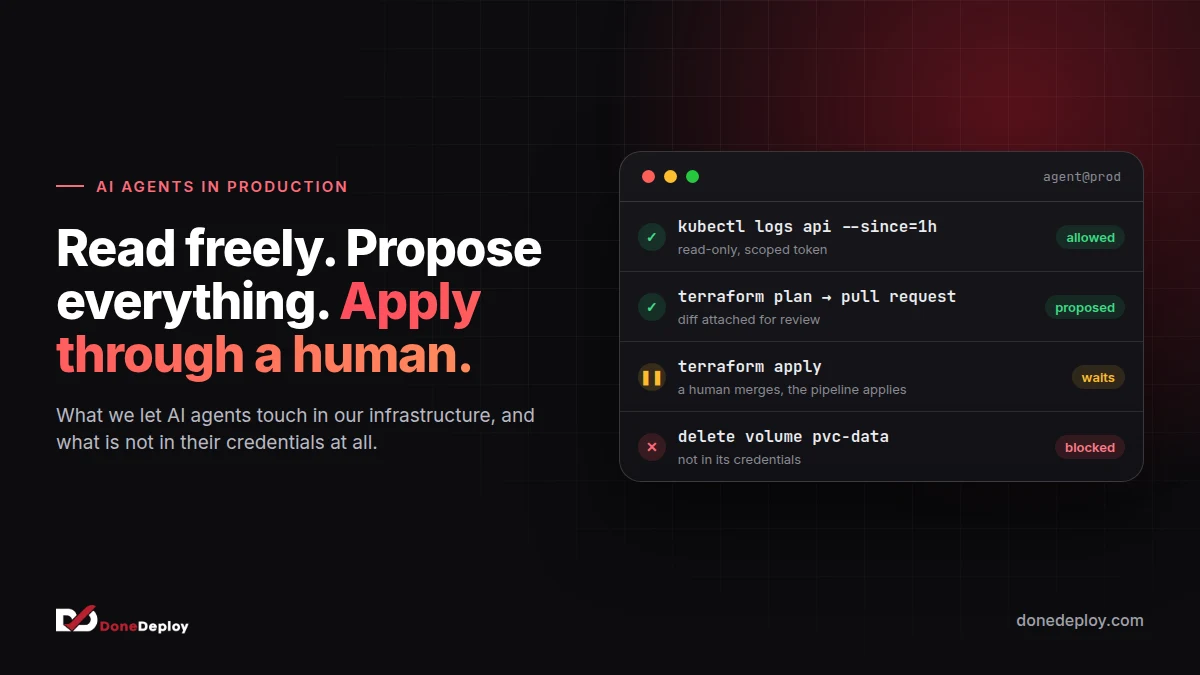 AI Agents in Your Infrastructure: What We Let Them TouchAI agents can read logs, write Terraform and open pull requests. Here is where we draw the line in production: read freely, propose everything, apply only through a human.
 CI/CD for Models and PromptsEvaluation gates, model registries, canary releases and rollback: applying CI/CD discipline to prompts and models in LLM applications.
 Simpler Infrastructure, Faster Engineering TeamsSimpler infrastructure helps engineering teams move faster, deploy more efficiently, and focus on building products.